The First Platform Built to Capture API Enforcement Evidence
API Gateway Enforcement Evidence, Reimagined
Continuously prove how your gateway enforces security — without log pipelines, sampling, or reconstruction guesswork.
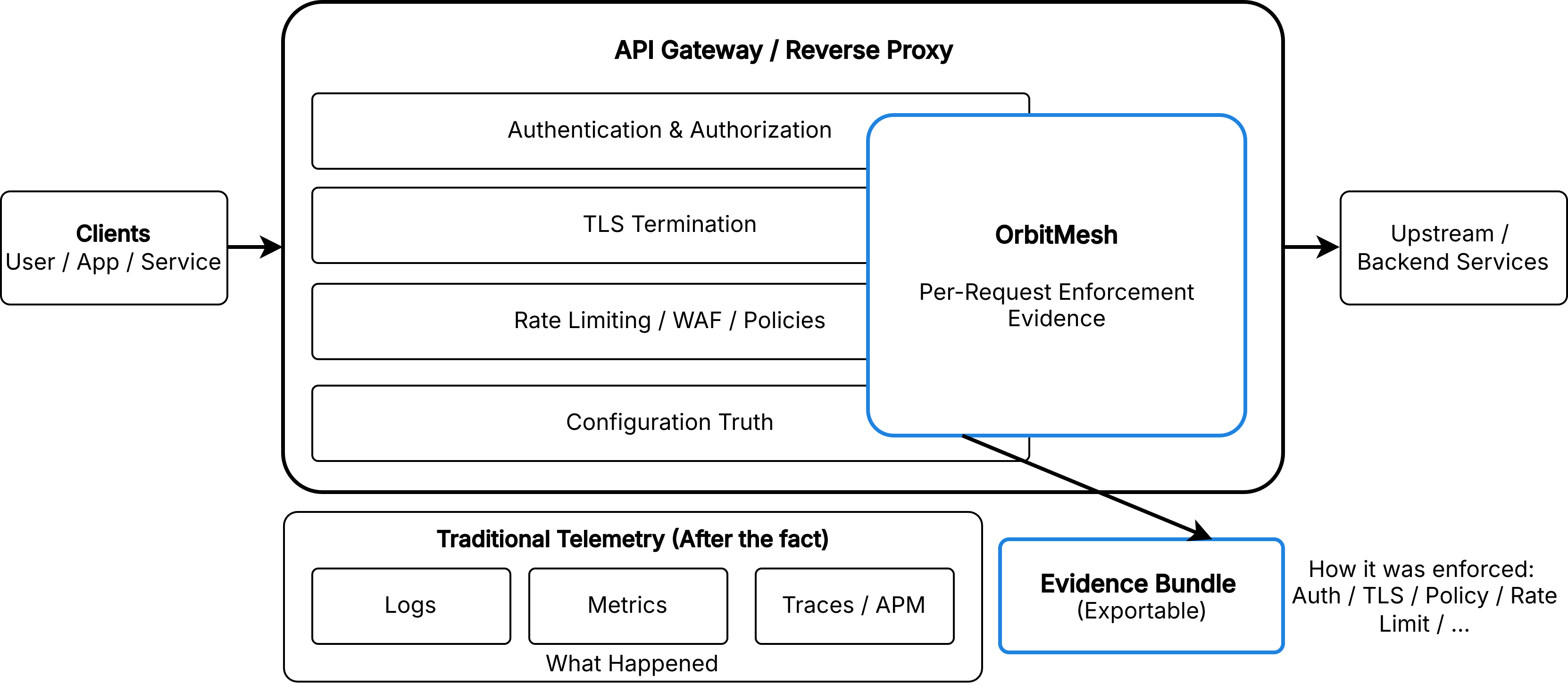
OrbitMesh captures enforcement decisions at the gateway data plane and turns them into continuous enforcement intelligence — not just logs or audit artifacts.
Why OrbitMesh?
Continuous Enforcement Verification
Continuously verify that authentication, TLS, rate limits, and security policies are actually enforced - not just configured.
Detect Enforcement Drift
Automatically detect when enforcement behavior changes after config updates, reloads, or certificate rotations.
Change Impact Confidence
Compare enforcement behavior before and after changes to prove security posture wasn't weakened.
Monitor-Only, No Risk
Runs in monitor-only mode at the gateway. Never blocks, modifies, or influences traffic. Engineered for near-zero latency and no impact on p99.
Prove Every Control
Capture per-request evidence of what the gateway actually enforced — not what was intended or logged.
No Log Pipelines for Proof
Enforcement evidence is compact by design, enabling long-term retention without SIEM-heavy workflows.
Compliance-Ready
Export evidence bundles for audits. Create tickets with fixed-on dates.
Defensible Audit Evidence
Each record is tamper-evident, with a verifiable chain of evidence you can hand to auditors for SOC 2, PCI, DORA, and more.
SIEM-Compatible
Export evidence alongside existing SIEM, GRC, and compliance tools — no vendor lock-in.
Easy Install, No Disruption
Deploy audit-grade enforcement evidence in minutes, without blocking or modifying traffic. Operational safety by design.
Multi-Gateway Support
Works with NGINX today. Envoy support is planned. Other gateways (Kong, AWS API Gateway, etc.) are on our roadmap for future releases. Unified observability for your evolving API infrastructure.
Open Source Dataplane
OrbitMesh's core dataplane is open source, enabling transparency, extensibility, and community-driven innovation for enforcement evidence at the gateway layer.
What Teams Use OrbitMesh For - And Why
OrbitMesh is used daily by security, platform, and compliance teams to continuously verify that API gateways are enforcing security correctly.
Security Teams
Detect enforcement drift and auth gaps
Validate TLS, mTLS, and policy enforcement
Explain why requests were allowed or blocked without guesswork
Prove absence of security violations
Platform / SRE Teams
Verify gateway changes didn't weaken security
Reduce MTTR without log reconstruction
Catch silent misconfigurations after reloads
Gain confidence in production rollouts
Compliance & GRC
Generate audit-ready enforcement evidence bundles
Maintain immutable enforcement history
Respond to regulators and customers faster
Eliminate manual evidence reconstruction
Security Leadership
Measure enforcement effectiveness over time
Track security posture across environments
Prove security improvements from changes
Reduce audit and incident risk
Enforcement Intelligence (Beyond Evidence)
Evidence is the foundation. Enforcement intelligence is the outcome. These capabilities are built exclusively on per-request enforcement truth — not inferred telemetry.
Enforcement Drift Detection
Automatically detect when gateway enforcement behavior changes unexpectedly.
Instantly explain why a request was allowed or blocked — based on enforcement decisions.
Policy match · Claim evaluation · Rate-limit outcome
Change Impact Verification
Prove that gateway changes did not weaken security enforcement.
Config updates · Cert rotation · Policy rollout
No payload inspection. No black-box AI. Only explainable insights derived from real enforcement behavior.
Ready to Transform from"what happened" to "how it was enforced"?
Join leading security and platform teams leveraging enforcement intelligence to continuously validate API security, streamline compliance, and reduce operational overhead — every day, not just during audits.
OrbitMesh defines a new category focused on cryptographically verifiable API gateway enforcement evidence, distinct from observability, logging, API security, and SIEM platforms.
Join the waitlist
Tell us your gateway and SIEM. We’ll prioritize integrations based on real demand.
We’ll only use this to prioritize integrations and contact you about early access.